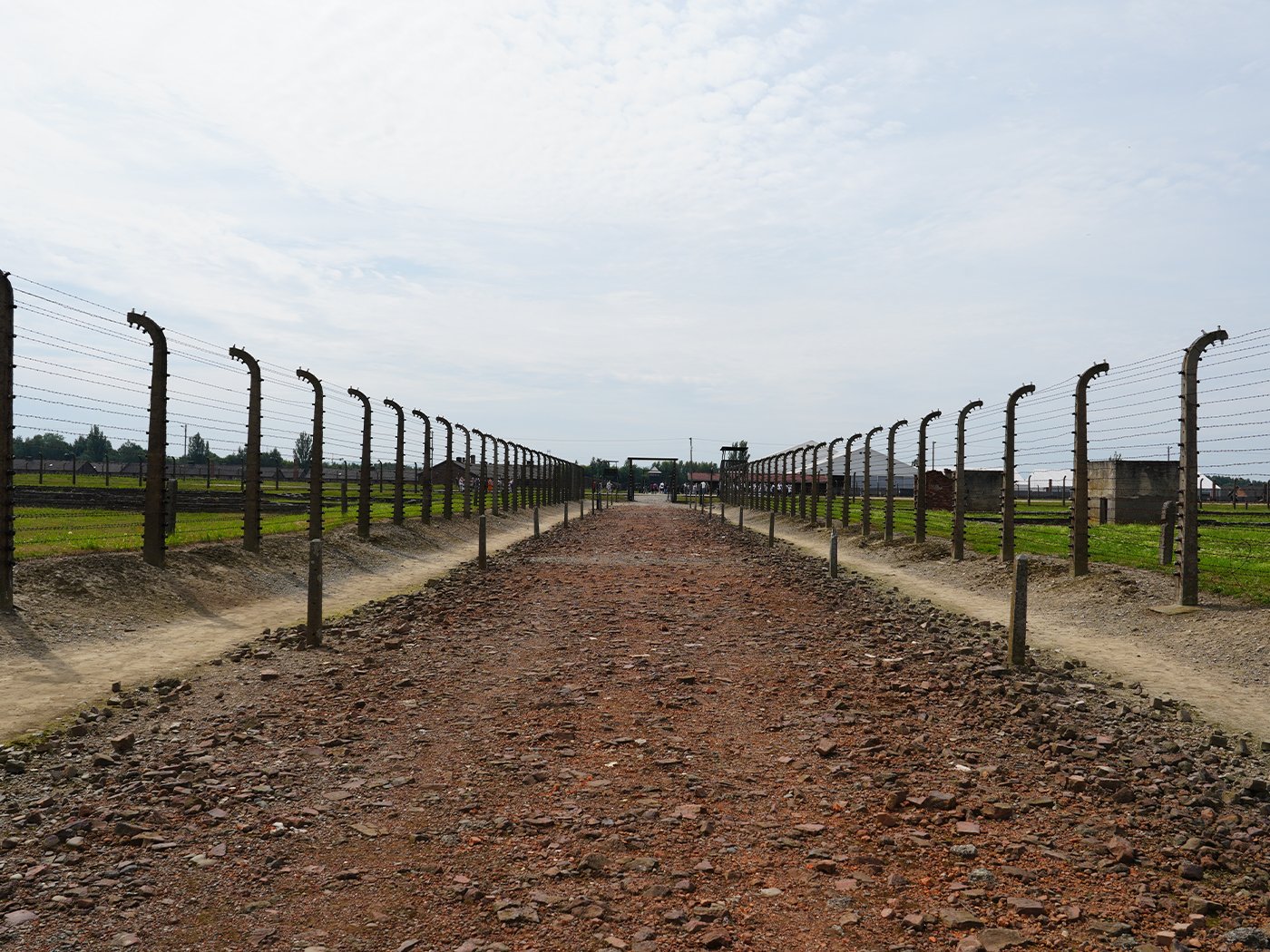
As Europe's democratic order weakens, the political cost of excluding Roma is falling. But Roma are not waiting for recognition—and turning our resistance into organised political power is becoming more urgent.
Eighty-two years after the uprising at Auschwitz-Birkenau, the question is no longer whether our people can act collectively. History has answered that question repeatedly, under conditions far harsher than those we are facing in Europe today. The real question is what political survival requires when the system is designed to keep us out of power.
On 16 May 1944, the SS came to liquidate the “Gypsy family camp” at Auschwitz-Birkenau. Roughly 6,000 of our people there were starving, diseased, isolated and marked for extermination. They possessed no army, no state, no institutional protection. Yet when the SS came, they organised resistance with whatever remained available: improvised weapons, coordination and refusal. The uprising did not save them. On 2 August 1944, the camp was liquidated, and roughly 4,300 Roma were murdered in the gas chambers. But under conditions designed to eliminate the possibility of collective action, resistance had emerged.
Europe has long found it easier to frame Roma history as a humanitarian tragedy rather than political history, because agency creates obligations that victimhood does not. The order built after 1945 made it easy to defer those obligations or ignore them altogether.
Europe reorganised itself around states, borders and recognised national majorities. Roma had no state, no territorial monopoly and no place at the table when the settlement was made. My father, Bajram Haliti, later argued that the postwar order did not fail Roma accidentally; it was built without recognising Roma as a political subject at all. There was no Nuremberg for the Roma genocide.
For decades, much of Europe classified Roma as "asocial" rather than victims of racial persecution, limiting responsibility for restitution and compensation after the war. The consequences extended far beyond memory. Alongside the mass killing of Roma across Europe came the loss of property, trades, family networks and intergenerational wealth. The socioeconomic condition of Roma in much of Europe today cannot be understood outside that history.
Under communist regimes, many Roma entered industrial labour and state welfare systems for the first time, but often at the cost of forced settlement, cultural suppression, coerced sterilisation and the destruction of independent forms of economic and social organisation.
Our first political response came in April 1971, when the First World Romani Congress convened near London and adopted the flag, the anthem Gelem Gelem and the name "Roma".
When the communist systems collapsed after 1989, many Roma were pushed back into exclusion without property, capital or political protection. Europe approached our agenda through integration, social assistance and cultural recognition. These efforts produced real gains. Civil society networks expanded. Anti-discrimination frameworks emerged. Transnational Roma institutions developed. But visibility gradually became confused with power.
In 2001, two of the main architects of Roma policy in Europe—Nicolae Gheorghe and Andrzej Mirga—warned that Roma political elites were losing influence over the institutions built to serve them, and that governments were increasingly using Roma policy for political display rather than actual change.
The lessons of the 25 years since that warning are clear. Engagement generates visibility. Only enforcement generates power. We engaged for a generation. The visibility came. The power did not.
That distinction matters more now, as the order that delivered even those limited gains begins to weaken. Xenophobic nationalists and anti-democratic forces are getting stronger. Economic insecurity is deepening. Security and fear are increasingly crowding out democratic debate.
As the order weakens, the political cost of exclusion falls with it. Courts rule and nothing follows. Romania's electoral rules for Roma representation have been condemned twice by the European Court of Human Rights and remain in place. Public discourse increasingly frames our people as a burden or risk to be managed.
At the same time, organised Roma political action faces coordinated disinformation campaigns, surveillance, economic pressure, deliberate political marginalisation and violence. The cost of exclusion is falling. The price of resistance is rising.
And yet our people resist. In Romania, in May 2025, large-scale Roma electoral mobilisation in 144 municipalities delivered 105,402 net votes against the far-right AUR candidate George Simion. In Hungary in April 2026, our turnout reached 72.5% in 44 districts where közmunka—workfare conditioned on partisan compliance—has structured Roma economic life for 15 years. In Bulgaria, our voters turned away from the parties that had long taken their votes for granted, delivering a significant blow to one of the country's most powerful political machines. In Slovenia, our people continue resisting the Šutar Law, which treats Roma as a security threat. In Sofia, the Roma of Zaharna Fabrika, whose homes were demolished despite a European Court of Human Rights injunction, have remained on the site and continued to pursue their case through the courts.
These developments matter because they reveal something European systems have underestimated for decades, and something many Roma were taught to doubt about themselves: we are not politically passive. We never were.
But continuity is not the same as power. The traditions that carried our people through slavery, fascism, forced assimilation and exclusion were built for survival under hostile conditions, and they worked. They kept our language, memory, families and communities intact when no institution would recognise us. However, conditions around us are changing. Informal solidarity alone cannot defend our people against forced eviction, surveillance, disenfranchisement or laws designed to exclude us.
Those who came before us proved that our people could act collectively. Our generation faces a different task: turning that capacity into political power. That means organised voting, independent leadership, transnational coordination and media infrastructure. It means legal enforcement that holds when governments change and economic capacity that does not depend on state goodwill. This is how exclusion becomes politically costly and resistance politically sustainable. Democratic participation without enforceable power leaves our people permanently exposed when the order around us weakens.
How European democracies treat Roma has long been an early warning of broader political decline. Democracies rarely abolish rights universally at once. They erode unevenly, beginning with the populations least able to impose political costs. Language used against Roma does not remain confined to Roma. Once exclusion of one group is normalised, others become easier targets. That is why our question cannot be separated from the future of the European order itself.
The price has already been paid—by the prisoners at Auschwitz-Birkenau who gave proof that we could act, and by every generation since that kept our people together without a state to protect us. What we owe them is not just commemoration but organisation: institutions they did not have time to build, and enforcement mechanisms capable of turning our survival into power that cannot easily be taken away. What we owe our children is something many of our parents could not give us: political protection that does not depend on whether the order around us holds or fails.
The cost of exclusion is falling. The price of resistance is rising. We pay it anyway. We have always paid it. Between this 16 May and the next, our generation has only two things to do: raise the cost of excluding us, and lower the price of resisting. That is what turning our collective survival into organised political power means.

Mensur Haliti
Vice President for Democracy and Network Development
The latest

The Conditional Belonging of Bulgaria’s Roma
Unregistered, Uncompensated, Unbroken

EU Budget Tracking Rules Name Roma but Still Cannot Say Whether Their Lives Improve, Roma Foundation for Europe says
Browse by category
Campaigns
Events
Facts
Press
Voices
For media inquiries:
[email protected]Sign up here so you don’t miss out on campaign updates, upcoming events and other news from the Roma Foundation for Europe and our network.
Sign up for our newsletter