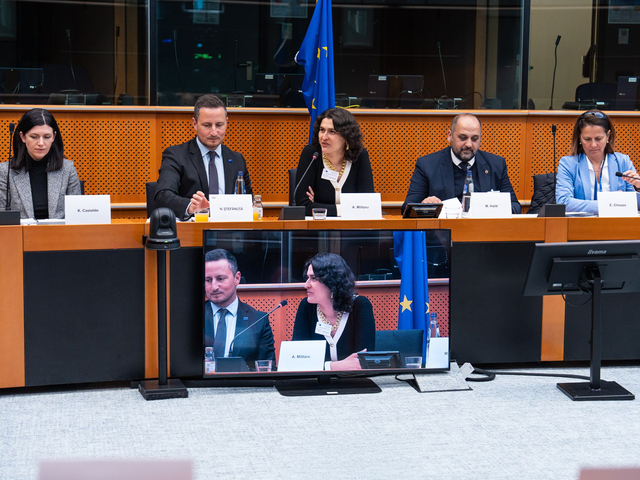
Democratic backsliding doesn't start at Europe's borders. A high-level roundtable in Brussels this week examined what it will take to build a Democracy Shield that works for everyone.
The Strengthening Democratic Resilience roundtable convened by the Roma for Democracy Foundation underscored a growing consensus: the EU's democratic crisis cannot be addressed by focusing solely on external threats while overlooking internal weaknesses.
In discussions on the Democracy Shield, electoral integrity and EU enlargement, participants agreed on a central point—what is not measured, monitored and meaningfully included remains unprotected.
"The current aspirations of the Shield show a weaker understanding of the complex dynamics on the ground. Roma participation is a key test of democratic resilience. We cannot focus only on external threats if the Shield fails to reach the political participation of 7–8 million Roma citizens, as well as those in candidate countries. We cannot afford this blind spot. What is not captured by the system is not protected by the system," warned European Parliament Vice-President Nicolae Ștefănuță.
The conversation made clear that Roma exclusion is not a peripheral issue, but a systemic weakness that undermines the credibility and resilience of democratic institutions.
Speakers highlighted that democratic backsliding often begins in spaces where oversight is weakest and accountability is limited.
Mensur Haliti, Vice President for Democracy and Network Development at the Roma Foundation for Europe, emphasised that vulnerabilities exploited by anti-democratic actors are not imported but "built, durable and invisible to oversight frameworks", with Roma communities frequently serving as early targets.
"The Democracy Shield cannot succeed," he argued, "if it excludes the largest ethnic minority in Europe—12 million Roma citizens. We have seen in many cases that some states continue to overlook the democratic potential and capacity of Roma communities. However, this is exactly the kind of vulnerability that foreign actors and anti-democratic forces seek to exploit. Ignoring Roma may have been tolerated in the past, but this is no longer just a Roma issue—it now affects the overall health and resilience of democracy itself."
This sentiment was echoed throughout the event, with strong calls to move beyond symbolic inclusion toward enforceable commitments embedded in legislation, budgets and institutional practice. Without safe conditions for participation, as noted by Roma Foundation for Europe President Zeljko Jovanovic, representation remains constrained, and generations risk being discouraged from engaging in public life.
At the same time, the discussions pointed to concrete pathways forward. Strengthening democratic resilience will require institutions that function with integrity and consistency, grounded in information from the ground and sustained engagement with communities on the ground. From using Roma-led data to detect early warning signs of democratic erosion, to building long-term partnerships between election observers and local organisations, participants stressed the need to connect policy with what's actually happening on the ground.
As Adela Militaru of Roma for Democracy concluded, democracy can only be protected when institutions move beyond doing the bare minimum and genuinely serve all citizens. The message emerging from the roundtable was clear: a Democracy Shield that fails to include Roma voices risks reinforcing the very vulnerabilities it seeks to address, while one that does has the potential to become effective, measurable and resilient.

Roma Foundation for Europe
The latest

The Conditional Belonging of Bulgaria’s Roma
Unregistered, Uncompensated, Unbroken

EU Budget Tracking Rules Name Roma but Still Cannot Say Whether Their Lives Improve, Roma Foundation for Europe says
Browse by category
Campaigns
Events
Facts
Press
Voices
For media inquiries:
[email protected]Sign up here so you don’t miss out on campaign updates, upcoming events and other news from the Roma Foundation for Europe and our network.
Sign up for our newsletter