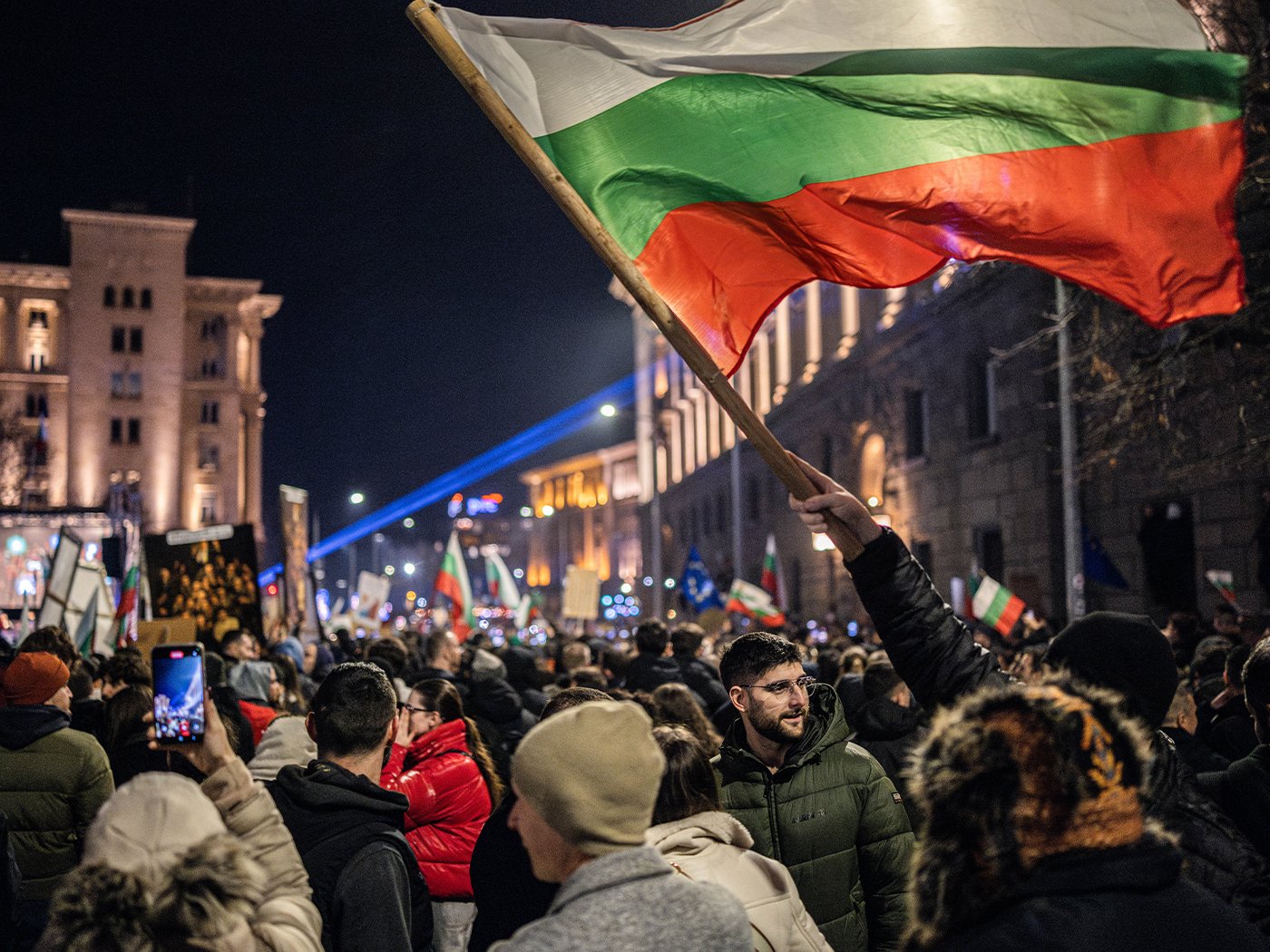
In Bulgaria's April election, the machinery of vote control ran at full capacity. It failed anyway—and the implications reach well beyond Bulgaria.
When polls closed in Bulgaria’s parliamentary election on 19 April—the country’s eighth in five years—the result showed something few European observers expected. The Roma electorate rejected the vote-buying, intimidation and neglect that three decades of coalitions had taken for granted. Those who voted turned away from parties that had treated them this way, and shifted support towards the former president and incoming prime minister Rumen Radev. The rest resisted more quietly, by not voting.
This all happened in an election marked by widespread irregularities, even as the caretaker government attempted to break the pattern of voter manipulation that has shaped Bulgarian elections for over 20 years. The April election recorded a reported 204 per cent increase in complaints compared to October 2024—nearly 3,000 in total. That could reflect more irregularities, or simply greater willingness to report them.
Either way, half of the complaints were traced to two major operators who had controlled the Roma vote for years. The first is Delyan Peevski—an oligarch sanctioned by the United States under the Magnitsky Act since 2021 —who has been linked to coercive control of the Roma vote in both his current and former parties. His Movement for Rights and Freedoms (MRF–DPS–NN) drew 631 allegations of vote-buying. The second is Boyko Borissov, who has governed for most of the period since 2009. His GERB–SDS drew 318 allegations.
The system designed to control Roma voters was operating at full capacity. Yet the voters it targeted disrupted it.
Vote Control Machine
This is not news in Bulgaria. Political actors have built a system for controlling Roma votes through five connected parts: local brokers, candidates, parties, law enforcement and courts. The broker delivers the votes. The candidate pays. The party covers up . Prosecutors decline to charge. Courts decline to convict. The Interior Ministry’s numbers show the first three working at scale. Peevski’s years without prosecution point to the fourth. The Constitutional Court’s 2025 forced recount, resisted by the Sofia prosecution, points to the fifth.
No Bulgarian coalition since the democratic transition has dismantled this system. The left has used Roma as symbols rather than political actors. The centre-right has relied on local intermediaries. Nationalist parties have expanded broker networks. The far right has weaponised anti-Roma sentiment to mobilise voters. Different actors, same structure.
Even when the pro-European We Continue the Change – Democratic Bulgaria (PP‒DB) government of 2023–2024 tried to deal with vote-buying, it chose the wrong strategy: policing without engagement. Uniformed officers were deployed to polling stations in areas with high Roma populations on election day, which deepened the existing fear and mistrust of Roma towards the state and the police in particular. Alongside the policing came a neglect that no Bulgarian coalition has fully abandoned: in 2026, PP–DB did not campaign in Roma neighbourhoods with the same intensity as elsewhere. The result was a collapse in turnout that weakened the Roma voice in the April election—even as the machine worked hard to deliver.
In the 210 polling stations with high numbers of Roma that the Roma for Democracy Foundation has analysed since 2021, weighted turnout fell to 19.4 per cent in June 2024—the end of the PP–DB government—and recovered only partially, to 27.3 per cent in April 2026. National turnout rose about 10 points over October 2024; in the monitored stations, it rose by only about 1 point. This gap is the widest recorded.
The Roma voters who abstained did not do so because they were not interested. For many, abstention was the only available way to reject both political control and political neglect. They refused to legitimise parties that either relied on vote control or took their support for granted. Abstention on that scale is not apathy. It is a political signal from voters whose choices have been constrained.
This machinery for controlling Roma voters is not Bulgaria’s alone. It is a deeper version of mechanisms in many EU member states and candidate countries.
The European Democracy Shield—the EU initiative intended to protect democratic processes from interference—being built in Brussels must be able to recognise them and act against them if it is to be effective.
What the Democracy Shield is designed to detect—foreign-funded disinformation, cross-border influence, hostile-state penetration—moves through structures the machine has already built. The Kremlin-linked network that the Balkan Investigative Reporting Network (BIRN) documented in 2024 and Russian-aligned operations across the region do not bypass it. They use it. Domestic capture is the infrastructure external actors cultivate. A defence instrument that addresses interference while leaving this infrastructure intact leaves the door open from inside. Bulgaria illustrates this point.
A Clear Message to the Winner
The response of Roma voters has to be read at two levels. Begin with those who did not vote. They withheld support from several parties at once: MRF networks that treated them as captive voters; a GERB apparatus that had relied on these practices for years; the Bulgarian Socialist Party (BSP), which no longer offered meaningful engagement; and PP-DB, which fielded Roma candidate Marin Tihomirov without matching that gesture with sustained outreach.
The second level is reflected in the ballot box. Those Roma who voted read the election with clear political judgement. GERB–SDS fell seven points nationally and 14 points among Roma voters. The split within the MRF redistributed votes nationally between Peevski’s MRF–DPS–NN and the “Alliance for Rights and Freedoms” faction; among Roma, however, their combined share was cut in half—a collapse redistribution alone cannot explain. In other words, the decline was not only the result of voters moving between rival MRF factions
PP–DB took 13.2 per cent nationally and 5.2 per cent among Roma. Its list in western Sofia was led by Marin Tihomirov—who had told a protest crowd on 10 December that “for 30 years, I watched how Borissov and Peevski bought my parents like tomatoes in the market.” He entered the 52nd National Assembly through personal mobilisation rather than party outreach. Representation without sustained engagement did not translate into support.
The parties that had run the machine lost more ground among Roma voters than anywhere else in the electorate. Those votes went to Radev’s Progressive Bulgaria—45.2 per cent among Roma, virtually his 44.7 per cent national share, achieved without outreach to Roma. And Vazrazhdane, Bulgaria’s pro-Russian far right, fell among Roma voters from 6.7 per cent to 2.9 per cent. A week earlier, Roma voters in Hungary had done the same to the far-right Mi Hazánk . This challenges a common assumption in European politics: that socially excluded voters are more likely to support far right parties. In these cases, they did the opposite.
Radev’s new government inherits both a mandate and a test. The expectations are concrete: whether prosecutors pursue the 631 vote-buying allegations; whether cases involving Magnitsky-sanctioned actors are investigated; whether courts issue convictions without external pressure; and whether police deployment in polling stations in Roma areas ends. Failure on any of these fronts will be seen as continuity under a different name.
The question has never been whether Roma will stand with democratic Bulgaria. The question is whether a party that calls itself progressive will make Bulgaria—and the EU—progress towards dismantling the machinery that corrodes democracy and enables foreign interference.

Mensur Haliti
Vice President for Democracy and Network Development
The latest

The Conditional Belonging of Bulgaria’s Roma
Unregistered, Uncompensated, Unbroken

EU Budget Tracking Rules Name Roma but Still Cannot Say Whether Their Lives Improve, Roma Foundation for Europe says
Browse by category
Campaigns
Events
Facts
Press
Voices
For media inquiries:
[email protected]Sign up here so you don’t miss out on campaign updates, upcoming events and other news from the Roma Foundation for Europe and our network.
Sign up for our newsletter