Roma success is readily absorbed into Bulgaria's national story, while Roma poverty is treated as a Roma problem. That double standard shows how provisional acceptance remains, even for people whose attachment to the country has never been in doubt.
Another Roma has just given Bulgaria a reason to be proud. At 22, Radoslav Rosenov became European boxing champion in Sofia, winning Bulgaria’s only gold medal at the championships and later being named the tournament’s best boxer. Yet what stayed with me was not the final bout, nor even the medal, but the footage that followed, in which Rosenov stood beneath the Bulgarian flag and sang the national anthem with such instinctive conviction that every word seemed to belong to him.
As a Bulgarian of Roma origin, I recognised something in that moment that was both beautiful and deeply uncomfortable, because the question has never really been whether Bulgarian Roma feel Bulgarian. We have lived in this country for generations, spoken its language, shaped its culture, carried its passports and, occasionally, carried its flag onto international podiums. The more interesting question is why Bulgaria’s capacity to recognise us as unequivocally its own becomes so much more generous when there is something valuable to be brought home.
There is a particular ambivalence in the way Roma have been treated across the Balkans. We can be close enough to embody the country when we give it something to celebrate, yet distant enough to become separate people when the story is less flattering. Music has always exposed this contradiction most clearly: Roma musicians have been admired, sought after and paid to provide the music through which generations of people have danced, married and celebrated, while admiration for their talent has never necessarily meant equal acceptance of the people themselves. Sport exposes a similar contradiction: when a Roma athlete brings home a medal, Roma identity can suddenly move almost effortlessly into the national “we”.
The problem is not that these achievements become Bulgarian, because they genuinely are Bulgarian. The problem is the selectivity with which collective ownership operates. A medal can belong naturally to Bulgaria, while poverty remains a Roma problem.
Sporting excellence can become evidence of Bulgarian talent, while exclusion is explained through Roma culture. The achievement travels towards the nation, while failure travels back towards the minority.
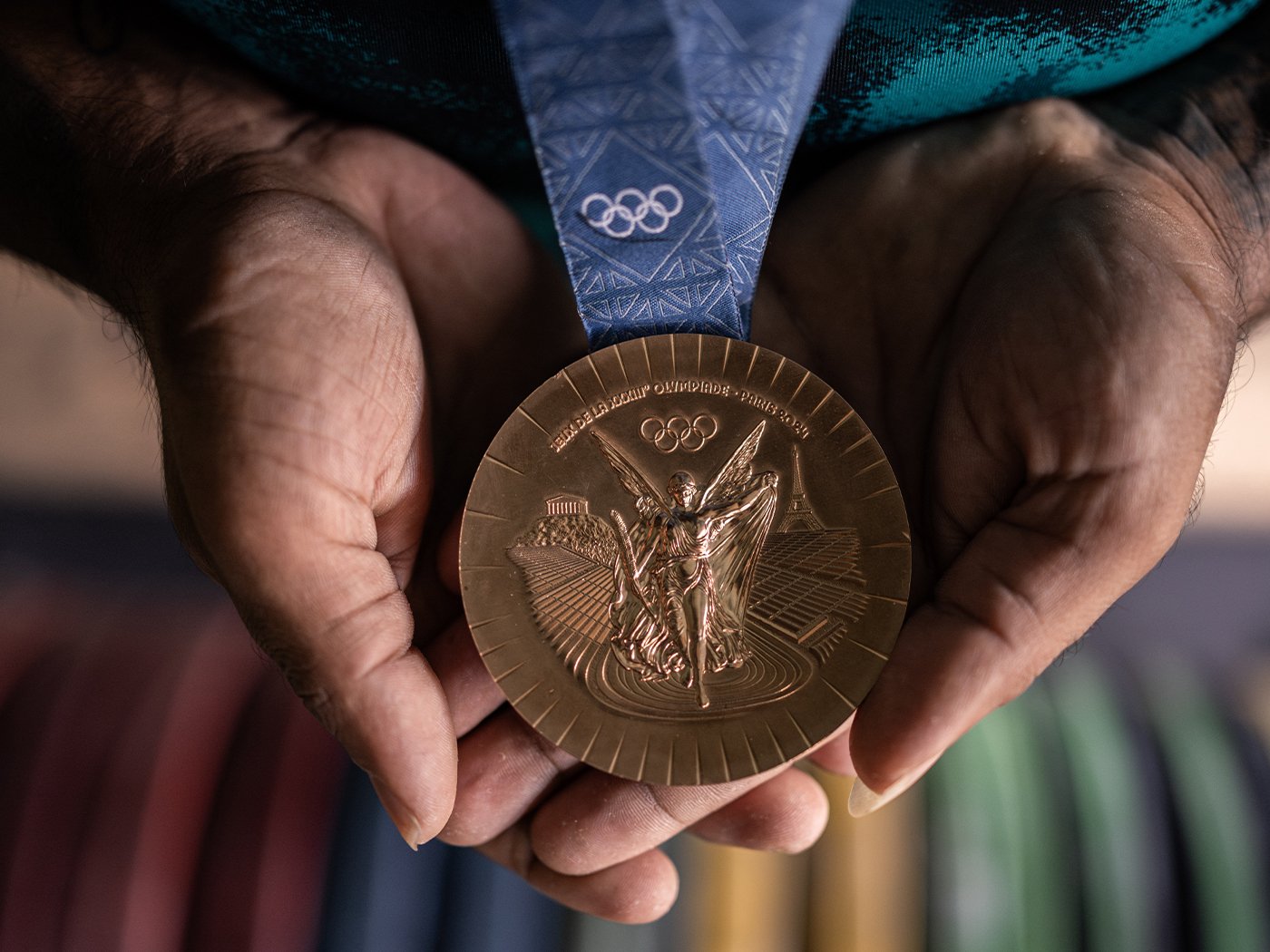
Bozhidar Andreev’s story makes this tension particularly difficult to ignore. Before winning Olympic bronze for Bulgaria in Paris in 2024, he had already become one of the country’s leading weightlifters, yet his journey began in poverty in the Roma neighbourhood of Topolchane. His sporting achievements eventually became national achievements, as they should have, although the circumstances from which he emerged were much easier to describe as a Roma problem than as a Bulgarian one.
This asymmetry matters because it tells us something about who is allowed to represent the nation and under what conditions. Bulgaria can inherit the victory without always inheriting the responsibility.
Even more revealing is the fascination with the “successful Roma”, a category that sounds complimentary until one considers what it implies. Europe has an estimated 10 to 12 million Roma, yet whenever one of us becomes a champion, an acclaimed artist, a doctor, an academic or a successful entrepreneur, the instinct is often to present that person as an exception, as though achievement has somehow lifted him out of the category to which he belongs. He becomes “different from the others”, and the compliment quietly preserves the prejudice it supposedly challenges, because instead of forcing society to reconsider what it believes about millions of Roma, exceptionalism allows it to admire one Roma while leaving its assumptions about everyone else perfectly intact.
This is what makes the burden of Roma success so peculiar. An ethnic Bulgarian does not need to become a European champion before anybody recognises him as Bulgarian, nor does his failure become evidence about millions of other Bulgarians. He is allowed the enormous privilege of being an individual, which means that he can succeed, fail, disappoint, contribute very little or contribute nothing at all without carrying an entire people on his shoulders.
Roma are still too often denied that ordinariness, because our failures are collectivised while our successes are exceptionalised.
Belonging cannot reasonably work that way, because citizenship that must constantly be earned through usefulness is not quite citizenship at all, in the emotional sense.
Maybe this is why Rosenov singing the anthem affected me more than the medal itself. There was nothing hesitant in the way he stood beneath that flag, and there was certainly nothing conditional about the pride with which he sang. The ambivalence lies elsewhere, because Roma attachment to Bulgaria has survived poverty, segregation, hostility and generations of being spoken about as though we were somehow adjacent to the country rather than part of it.
For decades, public debate has asked whether Roma want to integrate, whether Roma identify with Bulgaria and whether Roma feel sufficiently connected to the nation. Yet Rosenov standing on that podium makes another question considerably harder to avoid: what happens when a minority has spent generations proving its attachment to a country that still appears to recognise that attachment most comfortably when it arrives carrying a medal, a song or something else worth claiming?
Perhaps the problem was never that Roma did not know how to belong to Bulgaria.
Perhaps Bulgaria has simply been much better at recognising what Roma can give it than recognising Roma as entirely its own.

Daniela Samiri
Contributor
The latest
Unregistered, Uncompensated, Unbroken

EU Budget Tracking Rules Name Roma but Still Cannot Say Whether Their Lives Improve, Roma Foundation for Europe says
Roma Foundation for Europe Calls for Full Investigation into Death of Tamás B. Following Police Operation in Hungary
Browse by category
Campaigns
Events
Facts
Press
Voices
For media inquiries:
[email protected]Sign up here so you don’t miss out on campaign updates, upcoming events and other news from the Roma Foundation for Europe and our network.
Sign up for our newsletter